
GCSE vs IGCSE
What Should I Pick for My Child?
Over the past 20 years I have worked across education in a number of different settings – from primary schools to university level in London, through private tutoring, and for the past 15 years helping families navigate home education exams in the UK. That means I know the state school system from the inside. I have seen how GCSEs work in practice, what they ask of students, and how schools prepare young people for them.
I say that because I want to be clear: when I recommend IGCSE to home-educating families, it is not because I am unfamiliar with GCSEs or dismissive of them. It is because I have worked with both routes long enough to see where each one serves students well. And where the practical realities of GCSEs create unnecessary difficulties for students who are not sitting exams through a mainstream school.
So, should you choose GCSE or IGCSE for your child? The short answer is: for most home-educating families, I would recommend Edexcel IGCSE. Not because GCSEs are a poor qualification – they are not – but because IGCSEs are significantly more practical to sit as a private candidate. And let me walk through exactly why.
In a Nutshell
- GCSEs and IGCSEs are considered equivalent qualifications – universities, colleges and employers treat them the same
- IGCSEs are far easier to organise as a private candidate – fewer practical requirements, less coursework, lower costs
- IGCSEs offer exam sittings in both May/June and October/November, giving your child far more flexibility than GCSEs
- Edexcel has the widest range of textbooks, tutors and revision materials of any IGCSE provider
How do GCSEs and IGCSEs compare?
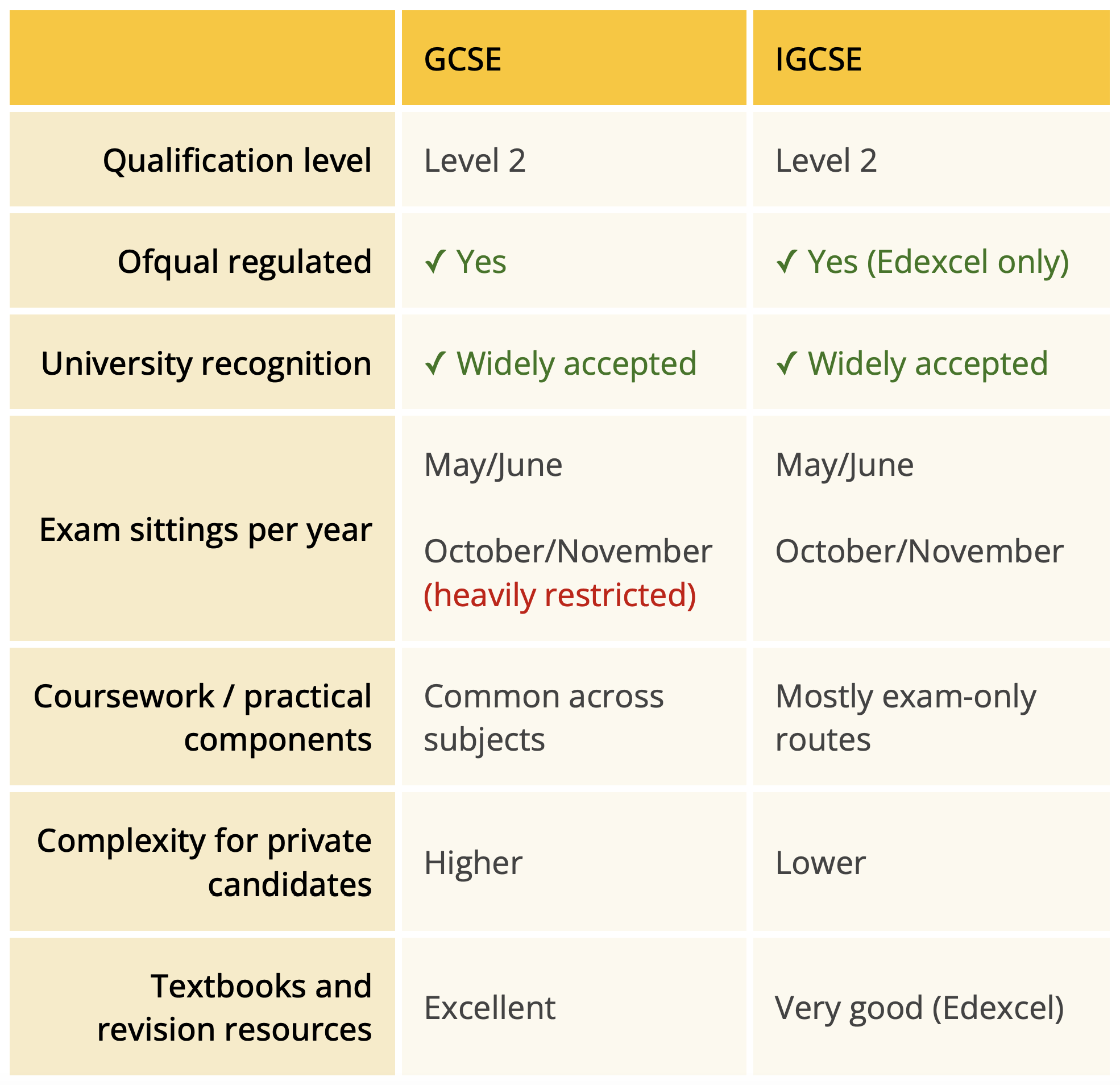
Before we get into the details, here is a quick overview. Both qualifications sit at the same level (Level 2) and both are widely recognised across the UK. The differences are almost entirely practical, and they matter much more for home-educated students than they do for students in mainstream schools.
The table below gives you the headline picture. Each row is explained in more detail below.
What is an IGCSE and why do home educators use them?
The “I” stands for International. IGCSEs were originally created for students at British international schools abroad, and for children of British families living overseas who intended to return to the UK. The idea was to give those students a qualification that matched British standards without the complications of converting foreign qualifications.
Over time, they have become increasingly popular here at home – and the reason is simple. When you are educating a child outside the mainstream school system, home education exams in the UK become much more straightforward with IGCSEs than with GCSEs. It is not about the academic content; it is about the practical logistics.
Some state schools no longer offer IGCSEs because of government funding rules and league table arrangements. As a home-educating family, none of that applies to you. You have the freedom to choose the qualification that works best for your child, and in my experience, that almost always means IGCSE.
Coursework and practicals: the thing that catches most families off guard
This is the area that surprises parents most when they first start researching home education exams in the UK. When most people hear the word “coursework”, they picture essays submitted over the course of the year. But coursework can also mean spoken language endorsements, required practical sessions and other non-exam assessments (NEA). And here is the frustrating part: even when these components do not contribute marks to the final grade, they still have to be formally organised and assessed.
As a home-educated student, your child will be sitting exams as what is known as a private candidate. This means registering through an approved exam centre rather than a school. When non-exam components are involved, those centres have to supervise, mark and authenticate the work. And not all of them are willing to do this.
What this can mean in practice for your family
- The work must be completed under controlled conditions at an approved exam centre
- You have to find a centre willing to supervise, mark and formally authenticate it
- Relatively few centres offer this service for private candidates – they can be hard to find
- Because availability is limited, the fees involved can be significant
Many IGCSE subjects offer straightforward exam-only routes, which removes all of the above. This is one of the most practical reasons I consistently recommend IGCSE to the families I work with. It is not about cutting corners; it is about removing unnecessary obstacles.
GCSE reforms in recent years have reduced traditional written coursework across many subjects. However, practical components and spoken assessments can still create real barriers for private candidates, so it is always worth checking the specific requirements of any subject before committing to it.
Important: Not all IGCSEs are entirely exam-based. Some subjects include optional coursework routes (such as Edexcel IGCSE English Language (Specification A, Route 2), while others, including Art & Design may require portfolios or practical assessments. It is always worth checking the specification carefully before selecting subjects.
English Language
English Language is where I have seen the choice of qualification make the most tangible difference to students’ results. Having taught both AQA GCSE English Language and Edexcel IGCSE English Language over many years, I can tell you that the Edexcel IGCSE consistently gives students better access to the higher grades. And the main reason comes down to whether students have seen the texts before they walk into the exam room.
Seen vs unseen texts: why it matters
In both qualifications, students analyse written texts and answer questions about them. The critical difference is this: in AQA GCSE English Language, all three texts are unseen, your child will most likely have never have read them, and most definitely not have studied them in any formal manner before the exam. In Edexcel IGCSE English Language, two of the three texts come from a set anthology that students study in advance. Only one is unseen.
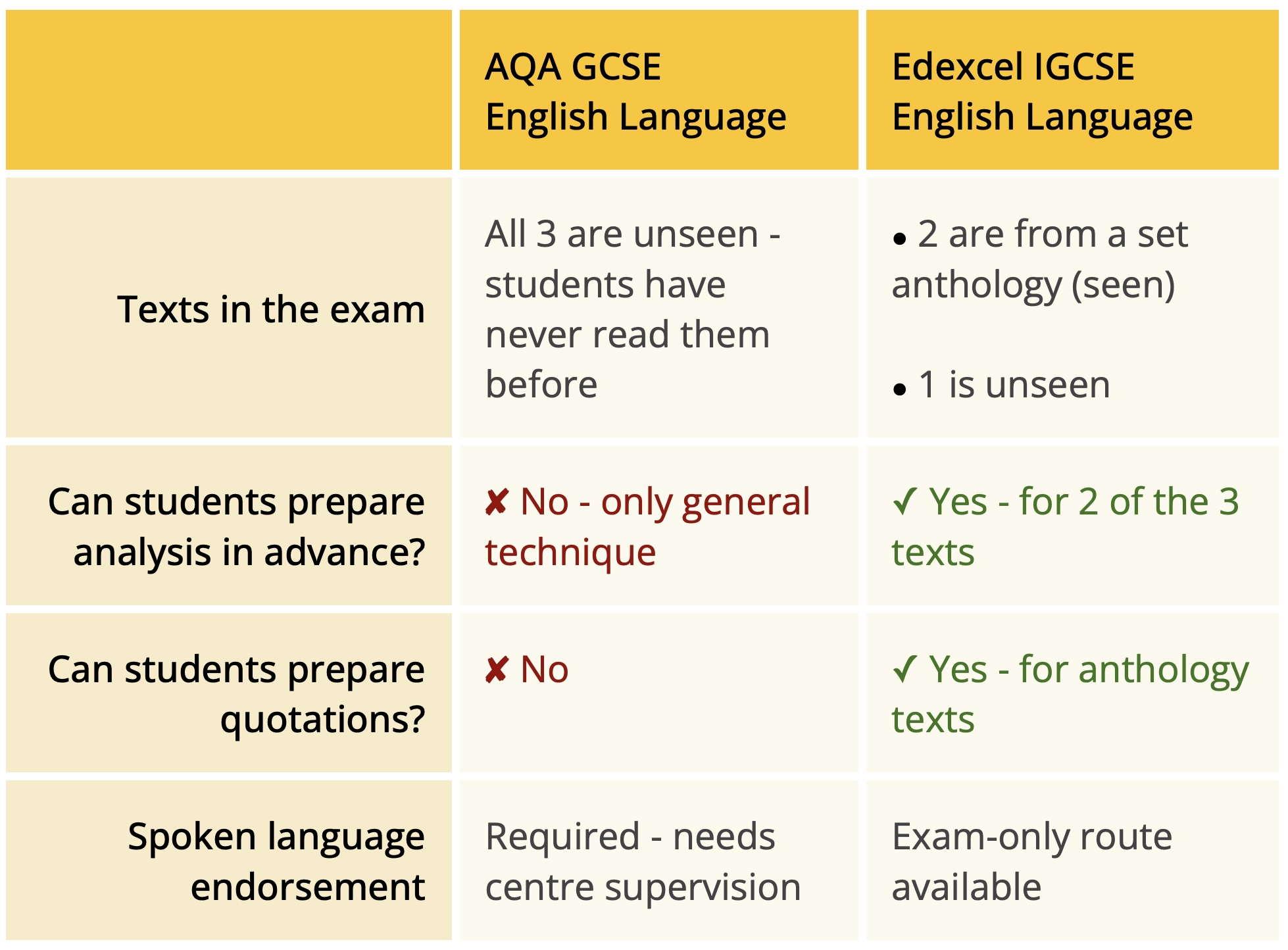
What this means in practice is that Edexcel IGCSE students can study the anthology texts in depth before the exam – building up their quotations, exploring themes and practising written responses. They go into the exam room having already done much of the analytical thinking and simply apply their preparation to the question being asked. For students who benefit from structure and preparation – and in my experience, that describes the majority of home-educated children – this can be a genuine game changer.
Students enter the exam already familiar with two-thirds of the textual analysis requirements. In practice, I have consistently found that this translates into stronger responses and higher marks.
The spoken language endorsement is also worth flagging. For GCSE English Language, students must complete a formal spoken assessment: graded Pass, Merit or Distinction. It does not count towards the final grade, but it still has to be organised and assessed by a centre. Finding a centre willing to do this for a private candidate can be difficult, and it is an obstacle that simply does not exist with Edexcel IGCSE.
English Literature
The differences in English Literature are equally significant and they come down to how much your child needs to memorise under exam pressure.
With AQA GCSE English Literature, students cannot take any of their texts into the exam room. That means the Shakespeare, the modern prose or drama and the 19th-century novel all have to be recalled entirely from memory – along with quotations from each. In the poetry section, students are given one poem on the exam paper, but they must then compare it with a second poem recalled entirely from memory. The volume of quotation memorisation involved is, frankly, enormous.
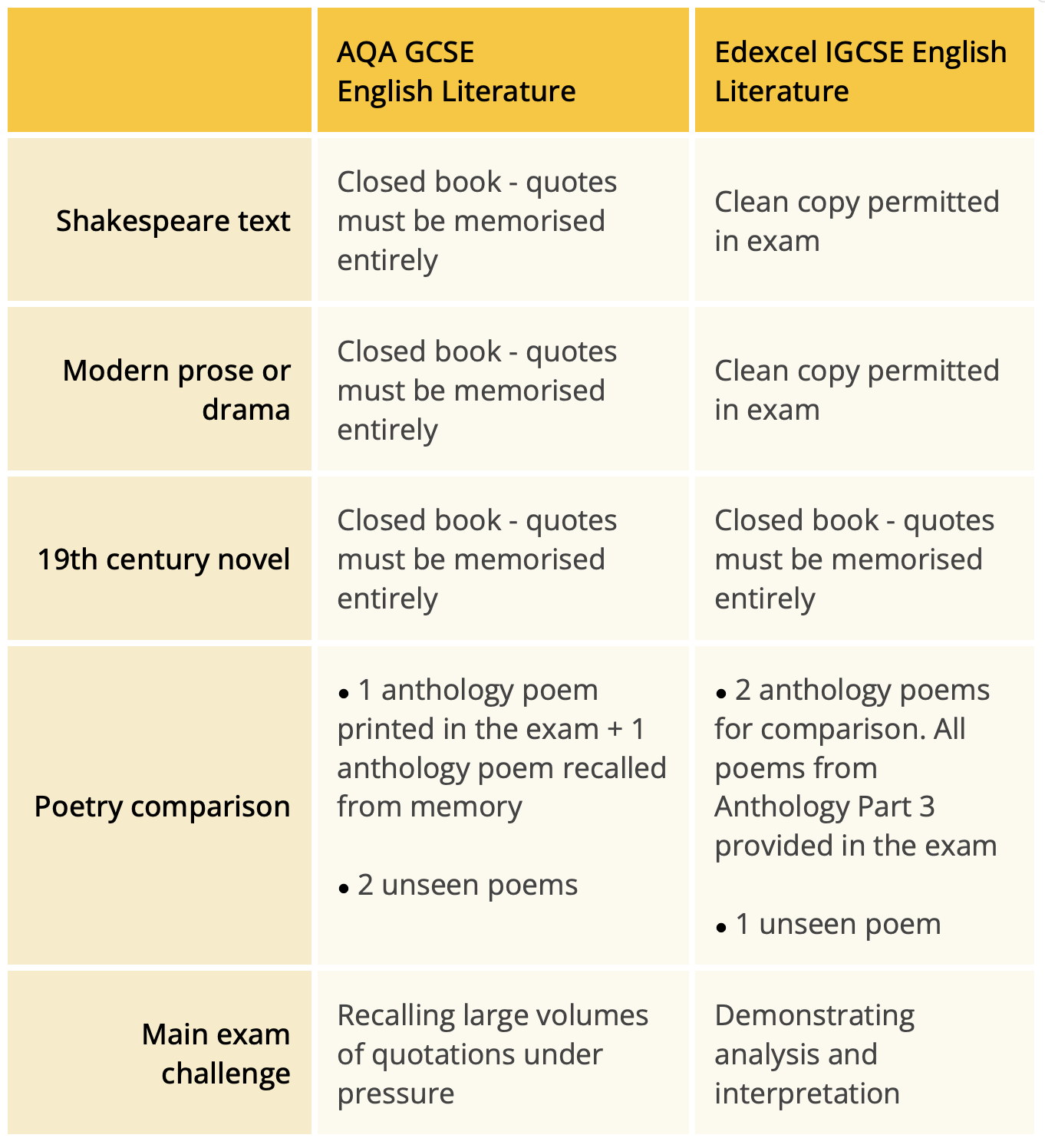
With Edexcel IGCSE English Literature, students are permitted to bring clean copies of the Shakespeare text and the modern prose or drama text into the exam. A clean copy means no annotations, no highlighting, no sticky notes – just the text itself. These copies are checked by the centre before the exam begins.
I want to be clear: students still need to know the texts thoroughly. Being able to bring a copy in does not remove the need for genuine literary understanding. But it does shift the focus entirely away from quotation memorisation and towards what actually matters – the quality of a student’s thinking and analysis.
Rather than assessing how many quotations a student can retain under pressure, it allows them to focus on interpretation, analysis and constructing thoughtful responses. For many students, this makes English Literature feel far more manageable – and I have seen it make a very real difference to attainment.
Science & Maths: What home educators need to know
These subjects are worth covering briefly because there are some practical differences that home-educating families are not always aware of.
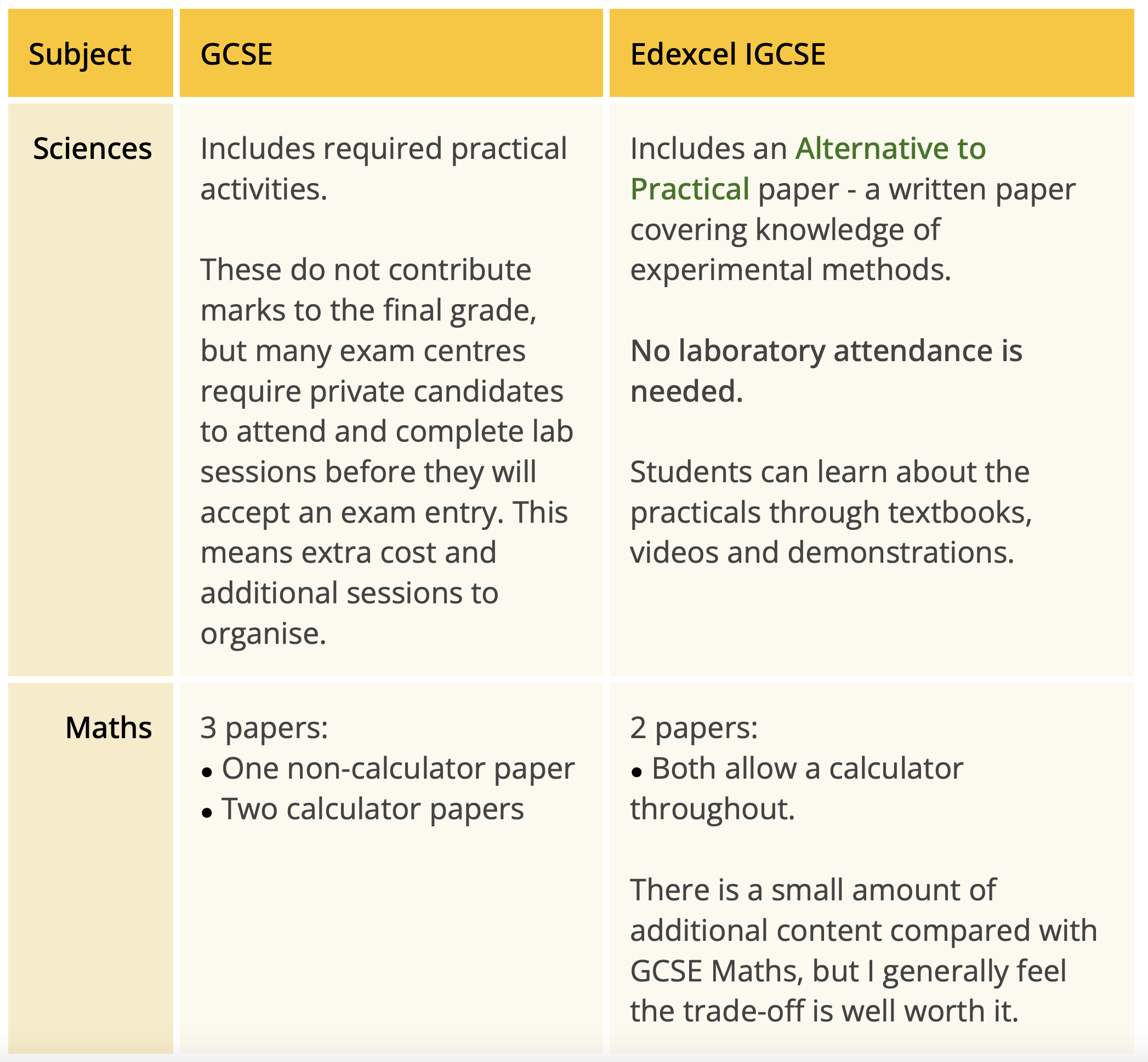
GCSE Maths does not involve coursework and can be sat as a private candidate without the practical complications that affect other subjects. That said, I tend to recommend Edexcel IGCSE Maths for most families – two papers instead of three and a calculator allowed throughout, makes for a less pressured experience overall.
When can your child sit their exams?
This is one of the most important differences between the two routes – and in my experience, one of the most frequently overlooked by families who are new to home education. GCSEs are built around the traditional school calendar. The assumption is that students will sit most or all of their exams at the end of Year 11, in the summer series. The November sitting is extremely limited.
The flexibility this gives home-educating families is, in my view, one of the strongest arguments for choosing IGCSE. Your child does not have to sit everything at once at the end of Year 11. Subjects can be spread across multiple exam series over several years. If a subject is ready early, it can be sat early. If more time is needed somewhere, there is space to take it. The pressure of a single high-stakes exam season can be removed entirely, and that matters enormously for many learners. This kind of flexibility is exactly what makes home education exams in the UK so much more manageable when you choose the right route.
IGCSE: Which exam board should you choose?
Once you have decided on IGCSE, the next question is which exam board to go with. There are three main providers of IGCSEs in the UK: Pearson Edexcel, Cambridge Assessment (CIE), and OxfordAQA.
All three are widely accepted by UK universities, colleges and employers, so recognition alone is not a reason to choose one over another. My recommendation is Edexcel, and the reasons are fairly straightforward.
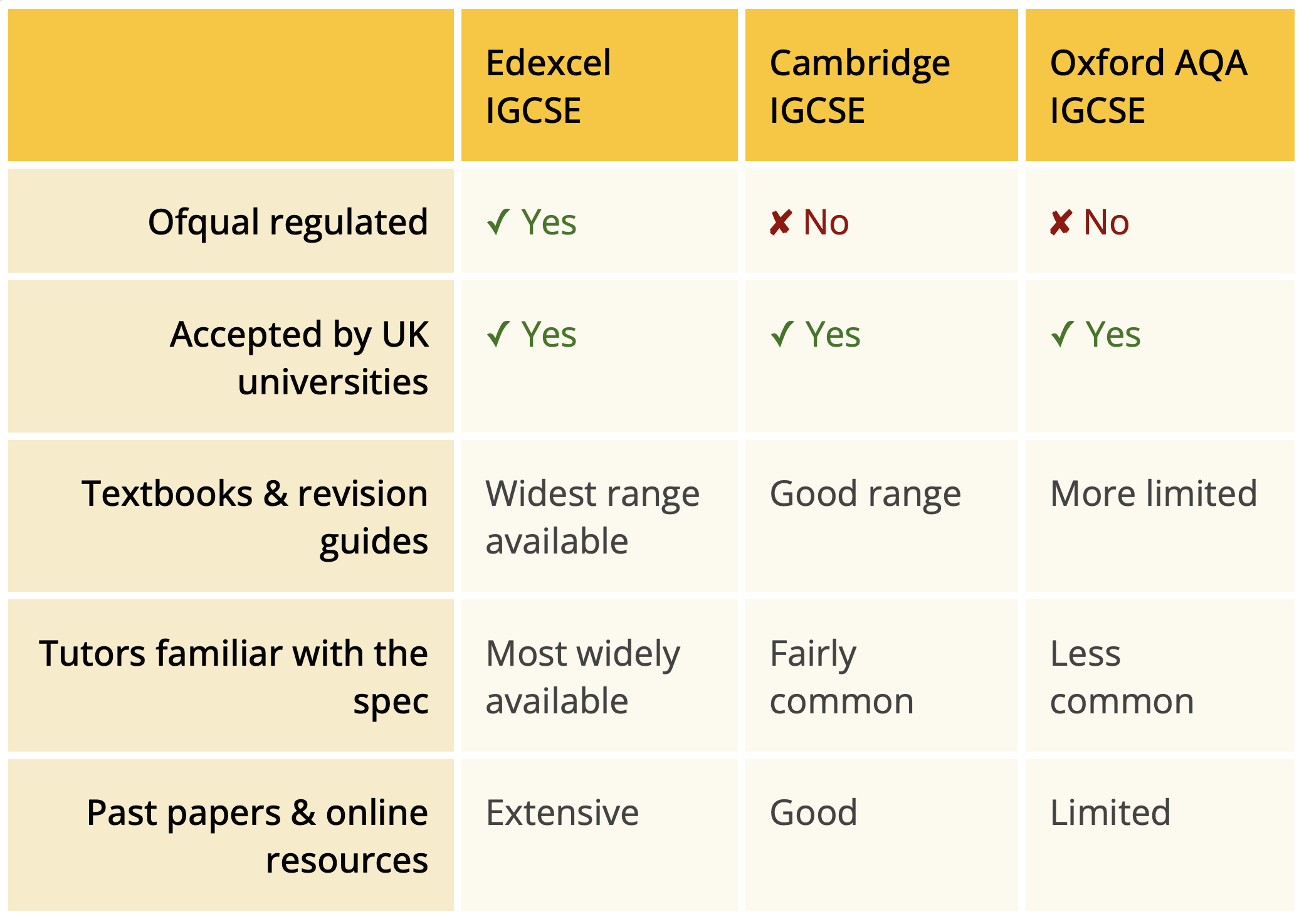
Ofqual (the Office of Qualifications and Examinations Regulation) is the government body responsible for regulating qualifications and exams in England. Edexcel is currently the only major IGCSE provider whose qualifications are Ofqual-regulated. Cambridge and OxfordAQA are not, though I want to be clear: all three are still fully accepted by universities and employers across the UK, so from a recognition point of view there is no meaningful disadvantage to any of them.
The practical reason I personally favour Edexcel is due to the resources available. There are simply more textbooks, more revision guides, more past papers, more video tutorials, and more tutors who know the Edexcel specifications. When you are doing much of the teaching at home, that breadth of available support makes an enormous difference.
An important point:
One piece of advice I give every family I work with: do not choose an exam board simply because it happens to be what your nearest exam centre offers. Choose the specification that suits your child first – then find a centre that accommodates it. The wrong specification can make the journey unnecessarily difficult, whereas the right one can make the whole process feel very manageable.
What would I recommend?
After 15 years of helping families navigate home education exams in the UK, my answer for the vast majority is the same: Edexcel IGCSE. Here is a quick summary based on what tends to matter most to the families I work with:
Qualifications exist to serve your child – not the other way around.
My view, after many years of working with home-educating families, is this: qualifications exist to serve your child, not the other way around. The best option is not the most traditional one; it is the one that gives your child the greatest chance to succeed with the least unnecessary stress. For the vast majority of families I have worked with, Edexcel IGCSEs strike the best balance between flexibility, accessibility and support. I hope this guide has helped make that decision a little clearer.
Please note: the information in this article is accurate to the best of my knowledge at the time of writing, June 2026. Exam specifications, entry requirements and centre policies can change, so I would always recommend checking directly with the relevant exam board and your chosen exam centre before making any final decisions.



Connect with Us